Fixed Assets Manual - Setting up a fixed assets accounting system
Setting up a fixed assets accounting system
Before you can start using Exact Assets C/S, you should give a number of questions careful consideration. They determine the behavior of your company in a later stage. For example, whether you will use years, quarters or months as depreciation periods and which depreciation method (or methods) you will be using. Once you have answered these questions, you can set up your fixed assets accounting system. See Creating master data and defining settings.
Whichever method of depreciation is used, the total accumulated depreciation at the end of its tax life will equal the original tax basis of the property. It is important to differentiate between depreciation methods used in financial accounting and tax accounting. While methods like sum-of-the-years'-digits and double-declining-balance depreciation or depreciation based on actual value are used for financial accounting, tax legislation prescribes less accelerated methods, such as the straight-line method. It is generally to a company's advantage to take the shortest tax life possible. Also the difference of time between depreciation and cash can be used as a steering mechanism. Shorter lives and accelerated depreciation allows a company to receive tax benefits from depreciation sooner.
Use Exact Assets C/S to determine the value of your fixed assets over a period of time. The value of your assets reduces through time. The time during which an asset is used represents an economic value. This time is divided into periods. In each period the decrease in value of the asset is recorded in the general ledger. This decrease in value is referred to as 'depreciation costs'.
Calculating depreciation is necessary to ensure that your balance sheet shows the correct value of your fixed assets and your profit and loss statement the correct costs of your assets. There is therefore an important connection between the assets system and the financial system. By considering a few questions carefully, considerable advantage can be taken out of your accounting system.
Besides a good identification of your assets, you need to answer the following questions:
- How will you organize your fixed assets in the accounting system?
- How many periods will you use within a financial year?
- Which depreciation methods do you want to use in the reports?
- Which depreciation method do you want to use for actual depreciation in your financial accounting system?
Once these questions have been answered you can set up your fixed asset accounting system. However, for each fixed asset you create in Exact Assets C/S, you must decide:
- The total depreciation amount
- The number of periods
- The depreciation method used for the fixed asset
How to organize your fixed assets
In Exact Assets C/S there are three levels of fixed assets.
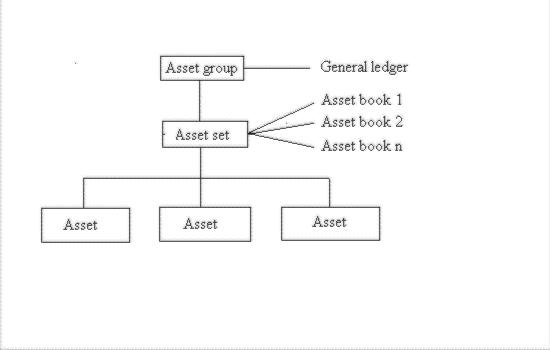
Asset group
The asset group groups assets and links between an asset to the general ledger. An asset group is the top level of your fixed assets organization chart. All assets grouped in the same asset group are linked to the same general ledger number. This way you have for example several cars in one asset group, so these are linked to the general ledger account 'Cars'. Through the asset group, the depreciation entries are recorded in the general ledger of the linked financial accounting system. The depreciation entries can be generated automatically per asset group, asset set or individual asset in a general journal. See Assets accounting system.
Asset set
The asset group groups to the general ledger. An asset set groups fixed assets with the same depreciation behaviour. An asset sett will be linked to an asset book and a depreciaton method. An asset book is linked to a calender. Every asset book is linked to a calender. For journalizing of, for example, depreciations the asset set is linked to an asset group.
Asset
An asset is the last and third level of your fixed assets organization chart. An asset is the actual durable means of production which is going to be depreciated.
Number of periods within a financial year
The time during which a fixed asset is depreciated is divided into periods. In each period the depreciation is calculated and possibly journalized. In Exact Fixed Assets C/S you can define periods yourself, for example, you can decide to depreciate only once a year, quarterly, or monthly. However, you can also divide the year into 13 periods of four weeks each. Take care! To each posting book a primary calendar should be linked. The posting book should always correspond to the period-date table created in Exact Finance C/S. So it is not possible to create a monthly period-date table and depreciate the financial transactions weekly. Calendars, different from the posting book/period-date table, can be created and linked to secondary asset books. Transactions in secondary asset books are not registered in Exact Finance C/S. This is to prevent inconsistencies.
See Calendar.
Depreciation methods to use
In Exact Assets C/S multiple valuation methods can be used simultaneously. These valuation methods are recorded per asset book. For different types of assets you can create different depreciation methods. You can also create different depreciation methods for one asset, in order to present or simulate your figures. In your reports you can calculate the value of the same fixed assets using different depreciation methods or calendars. Of course only one depreciation method will be used for actual depreciation in Exact Finance C/S.
Depreciation method to use for actual depreciation
In most countries you cannot change your depreciation method except in special circumstances. So consider carefully which depreciation method you will use for actual depreciation of your fixed asset. When you change it nevertheless, the old depreciation will be reversed.
Finance Manual C/S > Contents > Working with fixed assets > Setting up a fixed assets accounting system
XTwoFourNineX
| Main Category: |
Support Product Know How |
Document Type: |
Support - On-line help |
| Category: |
On-line help files |
Security level: |
All - 0 |
| Sub category: |
Details |
Document ID: |
06.840.543 |
| Assortment: |
Exact Financials (v3)
|
Date: |
21-11-2007 |
| Release: |
|
Attachment: |
|
| Disclaimer |